
Sand to Soil Part 9: From Dead Sand to Living Soil: The Transformation
By Jeremy Standring
We’ve reached the finale of our "Sand to Soil" journey, and what a ride it has been. If you’ve been following along, you know this all started with a simple, sterile bucket of pale garden sand. It had no structure, no life, and no ability to hold water. It was, for all intents and purposes, dead dirt.
Today, just three weeks into the active biological phase, we are standing next to a thriving five-gallon Rhizo Logic® cloth pot that looks more like a miniature forest than a sand pit. We’ve moved past the "experimental" phase and into the "proof" phase. In this post, we’re going to look at the visual transformation, dive deep into the data from our Bluelab Pulse and MicroBIOMETER, and recap the exact framework we used so you can replicate this success in your own backyard or farm.
The Visual Proof: Above and Below the Surface
The first thing anyone notices is the lush, green canopy of our legume cover crop. Only 21 days ago, we were looking at bare, damp sand. Now, the surface of the pot is completely obscured by vibrant growth. This isn't just for show; that canopy is protecting the soil surface from evaporation and providing a steady stream of carbon to the microbes below.

Above-Ground Vitality
When we look at the legume crop, we see "happy" plants. There is no yellowing, no stunting, and the leaf expansion is aggressive. This tells us several things about the environment we’ve built:
- Seed-to-Soil Contact: Our initial planting method worked.
- Moisture Stability: The plants haven't hit a wilting point, meaning the sand-compost mix is doing its job.
- Nutrient Availability: The biology is successfully cycling the organic NPK we applied.
Below-Ground Architecture
The real magic, however, is happening out of sight. When we carefully inspect the root zone near the edge of our Rhizo Logic® cloth pot, the transformation is staggering. We no longer have loose grains of sand that pour through your fingers. Instead, we have aggregation.
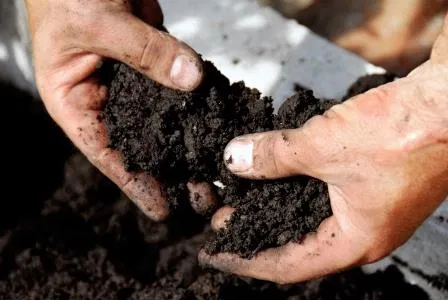
The soil is darker: a result of the humic substances in the compost and the glues produced by microbes. When you pull a small sample, it crumbles into "patties" and "crumbs." We are even starting to see those tiny, white, thread-like strands of fungal hyphae weaving the sand particles together. This is the beginning of a stable soil structure that can resist erosion and store water long-term.

The Data: Measuring the Pulse of the Soil
At Regen Soil, we don't just guess; we measure. We use the Bluelab Pulse Meter to get a real-time snapshot of what the roots are experiencing. Here are our measurements at the three-week mark:
- EC (Electrical Conductivity): 1.72 In the beginning, our dead sand had an EC near zero. An EC of 1.72 is a "sweet spot" for a living soil system. It shows that we have a healthy level of dissolved salts and nutrients available for the plants, but we haven't over-fertilized to the point of harming the microbial life.
- VWC (Volumetric Water Content): 24% This is perhaps the most important metric for sand restoration. Pure sand would either be 0% or 100% (flooded). A stable 24% means the organic matter and developing structure are holding a reservoir of water, making the system resilient.
- Rootzone Temperature: 74.3°F This temperature is the "Goldilocks zone" for biological activity. It’s warm enough for rapid microbial metabolism but cool enough to prevent plant stress and root rot.

By tracking these numbers, we can see that we have successfully transitioned from an inert mineral base to a biologically active medium. If you want to see how your own soil stacks up, we always recommend starting with an Initial Soil Health (ISH) Assessment.
The 5-Step Transformation Framework
How did we get here? We followed a logical, science-backed sequence that we call the RSI Method. If you are dealing with sandy soil, this is your blueprint for success.
1. High-Quality Compost (The Habitat)
We started by mixing high-quality, microbe-rich compost into the sand. This provided the "housing" and the initial "pantry" of organic matter. Sand provides the drainage, while compost provides the structure.
2. Biological Inoculation (The Workforce)
We didn't wait for life to show up on its own. We used compost teas and extracts to drench the pot. This introduced a concentrated dose of active bacteria, fungi, and protozoa. This "jump start" ensures that the sand particles are coated in biofilms immediately.
3. Living Roots (The Energy Source)
This is the step most people skip. Roots are the engine of soil health. By planting legumes, we ensured a constant supply of root exudates (sugars and proteins) to feed our new microbial workforce. Furthermore, the legumes work with Rhizobia bacteria to pull nitrogen out of the air and put it into the soil.
4. Balanced Organic NPK (The Support)
We applied a gentle, certified organic fertilizer. In a new system, the biology isn't always strong enough to provide 100% of the plant's needs immediately. This modest application supports the plants so they can grow bigger roots, which in turn feed more microbes. It’s a positive feedback loop.
5. Consistent Measurement (The Guidance)
By using tools like the MicroBIOMETER and the Bluelab Pulse, we avoided the "apply and pray" method. We knew exactly when the soil was thirsty and exactly when the nutrient levels were climbing.

From 5 Gallons to the Field: Scaling the Success
You might be wondering, "Jeremy, this is great for a pot, but what about my garden?"
The principles are exactly the same. Whether you are working in a Rhizo Logic® cloth pot, a raised bed, or a multi-acre field, the biological requirements of the soil do not change.
- For Home Gardeners: Focus on top-dressing with compost and using cover crops during the off-season.
- For Commercial Growers: Use liquid biological extracts through your fertigation lines to keep the "workforce" active across your entire acreage.
We’ve seen this transformation happen time and time again. You are not "stuck" with the soil you have. Soil is a living, breathing system that responds to proper management.
Final Thoughts: The Journey Continues
We’ve officially proven that you can take the most lifeless material: store-bought garden sand: and turn it into a functional, living ecosystem in less than a month. It takes intentionality, the right inputs, and a bit of patience, but the results speak for themselves.
Our "Sand to Soil" series may be wrapping up its initial phase, but the life inside this pot is just getting started. As the legumes grow and eventually die back, they will leave behind even more organic matter, further enriching the soil for whatever we decide to plant next.
Are you ready to stop fighting your dirt and start building soil? If you’re struggling with sandy patches or "dead" spots in your garden, don't give up. Reach out to us for a Soil Health Assessment or check out our blog for more deep dives into the world of regenerative agriculture.
Let’s grow something amazing together.
Frequently Asked Questions
Can I do this without compost tea?
You can, but it will take much longer. Compost tea acts as an "accelerant," bringing in millions of microbes that would otherwise have to migrate or wake up from dormancy on their own.
Why use a cloth pot like Rhizo Logic®?
Cloth pots provide superior aeration and prevent root circling. In a sand-to-soil transition, oxygen is vital for the aerobic microbes we are trying to encourage.
How often should I measure my EC?
In the beginning, we recommend checking once or twice a week. This helps you understand how quickly your plants are using nutrients and how well your soil is "buffering" the inputs.
Is this method expensive?
Actually, it’s often cheaper in the long run. By building a self-sustaining biological system, you reduce your reliance on expensive synthetic fertilizers and frequent watering.


