
Sand to Soil Part 6: Living Roots: The Engine of Soil Transformation
By Jeremy Standring
If you’ve been following along with our Sand to Soil series, you know we’ve been on a mission to prove that even the most "dead" garden sand can be brought back to life. Up until this point, we’ve handled the physical and the biological "starter" steps. We mixed in microbe-rich compost to provide habitat and organic matter, and we drenched the whole system with a biological jump-start: our compost tea.
But today, we are adding the most critical component. We are turning the key in the ignition. We are planting the living roots.
In the world of sustainable agriculture and regenerative farming practices, we often talk about soil health as if it’s something you can just buy in a bag. But the truth is, soil isn't just a collection of minerals and compost. Soil is a living, breathing ecosystem, and like any ecosystem, it needs a constant source of energy. That energy comes from the sun, but it’s delivered to the underground world via the plant.
In this episode, we’re planting a legume cover crop into our 5-gallon Rhizo Logic® cloth pot. This isn't just about growing a few green leaves on top; it’s about what happens beneath the surface.
Why Living Roots are Non-Negotiable
At Regen Soil, we have a saying: "A living root is the main energy source for the soil food web." Without a living root, your soil biology eventually goes dormant or dies off.
Think of it this way: the compost we added is the "house" for the microbes. The compost tea we drenched in is the "population." But the living roots? They are the "grocery store" and the "power plant" combined.
When a plant grows, it doesn’t just take from the soil. In fact, through the process of photosynthesis, a plant produces more energy than it needs for its own growth. It takes that excess carbon-based energy and pumps it down into the roots. From there, it "leaks" that energy into the soil in the form of root exudates.
The "Sugar Drip" for Microbes
These exudates are a complex cocktail of sugars, amino acids, and organic acids. We like to call it the "sugar drip." Why would a plant "leak" 20% to 40% of its hard-earned energy into the dirt? Because it’s hiring contractors.
The plant uses these sugars to attract and feed specific microbial populations. In exchange for the sugar, the microbes go out and mine minerals, protect the plant from pathogens, and build soil structure. This relationship is the foundation of living soil. Without the root, the "sugar drip" stops, and the microbial city starts to starve.

The Magic of Legumes and Nitrogen Fixation
For this specific experiment: turning sand into soil: we aren't just planting any old seed. We are using a legume cover crop.
Legumes (like clover, vetch, or field peas) are the heavy hitters of soil remediation. In a sandy, nutrient-poor environment, nitrogen is usually the biggest limiting factor. Legumes have the unique ability to form a symbiotic relationship with a specific type of bacteria called Rhizobia.
When we plant these seeds into our Rhizo Logic® living soil system, here is the play-by-play:
- Germination: The seed sprouts and sends a "signal" into the soil.
- Infection: Rhizobia bacteria in the soil respond to that signal and enter the root hairs.
- Nodule Formation: The plant builds little "houses" on its roots called nodules to keep the bacteria safe.
- Nitrogen Fixation: The bacteria take nitrogen gas from the air (which plants can't use) and convert it into a plant-available form.
This is a natural nitrogen factory. By using legumes, we aren't just adding fertilizer; we are teaching the soil how to make its own. This is a core pillar of the RSI Method (Regen Soil Innovations).
Hands-On: Planting in the Rhizo Logic® Cloth Pot
If you’re doing this at home in your own garden beds or containers, the process is simple, but the timing is everything. Our pot is currently a moist mix of sand, compost, and biological drench. It’s the perfect "nursery" environment.
Step-by-Step Planting Process
- Broadcast Seeding: We take our legume seed mix and broadcast it evenly over the surface. Since we are working in a small 5-gallon pot, I’m being a little heavy-handed with the seeds. We want a dense mat of roots to colonize every inch of that sand.
- Light Coverage: We don't want to bury these seeds six inches deep. We just add a light dusting: about a quarter-inch: of our sand-compost mix. This protects the seed from drying out while making it easy for the first shoot to reach the light.
- The Gentle Water: We give it a light mist. We don't want to wash all the seeds to the edge of the pot. We want them to stay exactly where we put them.
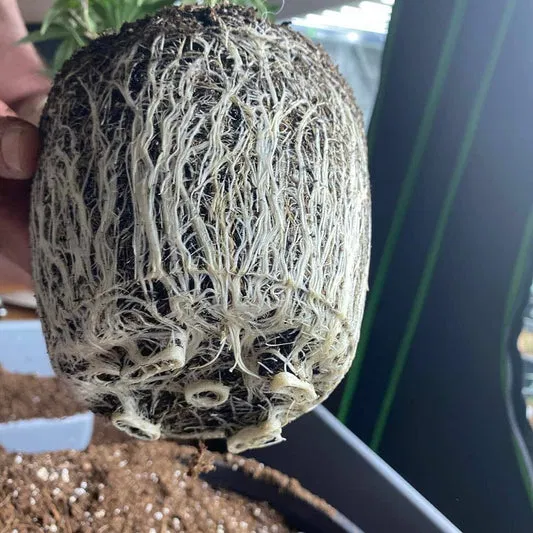
The choice of a Rhizo Logic® cloth pot is intentional here. Unlike plastic pots, these cloth pots allow for "air pruning." When the roots hit the side of the bag, they don't circle around and become root-bound; they stop and branch out, creating a much more fibrous and dense root system. More roots = more exudates = more soil microbial diversity.

Plants Feed the Soil: Debunking the Take-Only Myth
There is a common misconception in traditional gardening that plants are "takers": that they simply suck the life out of the soil until you have to add more "NPK" in a blue bottle.
We have found that the opposite is true in a regenerative system. A healthy plant is a net contributor to the soil. As the legume crop grows, it is physically binding the sand particles together. The "glues" produced by the bacteria (stimulated by the roots) create soil aggregates. These aggregates are what transform loose, leaky sand into a structure that can actually hold water and nutrients.
If you leave your soil bare, you are essentially leaving your microbes out in the sun to starve. By keeping a "living root in the ground" year-round, you ensure that the transformation from sand to soil never stops.
Guidance for Every Grower
Whether you’re just starting with a single pot on your balcony or managing a commercial farm, the principle of the "Living Root" remains the same.
For Beginners
Don’t overthink the seed choice. A simple white clover or even some leftover peas from the kitchen can act as a cover crop. The goal is to see green on top and know there is action below. If you want to take the guesswork out of it, our Initial Soil Health Assessment can help you determine exactly what your specific soil is missing before you plant. You can learn more about that at our assessment page.
For Experienced Growers
If you've already got your microbial ratios dialed in, focus on the fungal-to-bacterial (F:B) ratio. Fungi love the stable environment provided by the woody roots of certain cover crops. As your legumes mature, they provide the perfect scaffolding for mycorrhizal fungi to expand their network, effectively increasing your root surface area by up to 100x.
For Commercial Operations
Cover cropping at scale is the single most effective way to reduce your input costs. By leveraging nitrogen fixation and improved nutrient cycling, you can significantly back off on synthetic fertilizers. This not only saves money but also builds the long-term resilience of your land against drought and erosion.
What to Watch for in the Coming Weeks
Now that the seeds are in, the real "Sand to Soil" transformation begins. We aren't just waiting for "plants" to grow; we are waiting for a living system to wake up.
In the next few episodes, we’re going to be pulling out the big guns: the Bluelab Pulse and the MicroBIOMETER. We’ll be looking for:
- VWC (Volumetric Water Content): Is our new soil holding onto water better than the "leaky straw" sand we started with?
- EC (Electrical Conductivity): Are we seeing a steady rise in available nutrients as the microbes start mining the sand?
- Microbial Biomass: How much has our "biological population" exploded now that the grocery store (the roots) is open for business?
Conclusion
Turning sand into soil isn't a miracle; it's a biological process. By providing habitat (compost), life (tea), and energy (roots), we are working with nature instead of trying to bypass it. The Rhizo Logic® approach is all about setting the stage and letting the microbes do what they’ve been doing for millions of years.
If you’re struggling with sandy soil on your land, don't give up. Start small, get a living root in the ground, and watch the transformation happen from the bottom up.
Have questions about which cover crop is right for your soil type? Drop a comment below or reach out for a personalized soil health consultation. Let’s grow together!
FAQ: Living Roots and Soil Remediation
Q: Can I just use any plant as a cover crop?
A: Technically, any living root is better than no root. However, legumes are preferred for soil remediation because of their nitrogen-fixing capabilities. Grasses like cereal rye are great for adding high amounts of carbon and "fluffing" the soil.
Q: How long does it take for the roots to start changing the soil?
A: You’ll see physical changes (like clumping and darkening) within just a few weeks of germination. The deep biological transformation usually takes a full growing cycle to really stabilize.
Q: Do I need to add fertilizer if I’m using cover crops?
A: In the beginning, a small dose of a balanced, certified organic N-P-K fertilizer can help the cover crop get established, especially in "dead" sand. Over time, the goal is to let the biology and roots take over the heavy lifting.
Q: What happens when the cover crop gets too big?
A: You can "terminate" it by crimping it down or mowing it. The dying roots become food for a whole new set of microbes, and the top growth becomes a nutrient-rich mulch for your next "main" crop. This is the heart of regenerative farming practices.


