
Your Quick-Start Guide to Soil Archives: How to Document and Restore Your Land’s Legacy
By Jeremy Standring
Most people look at a field and see dirt. We look at a field and see a biological hard drive.
Every square inch of your land contains a data-rich history of every drought, every flood, every chemical application, and every successful harvest. But here’s the kicker: if you aren’t documenting that history, you’re essentially trying to run a business without an accounting ledger. In the world of regenerative agriculture, we call this process "Soil Archiving," and it is the single most important thing you can do to future-proof your land’s health and value.
Whether you are a backyard gardener trying to turn your patio into a high-yield haven or a commercial operator managing hundreds of acres, understanding your land’s legacy is the first step toward true soil restoration.
What Exactly is a Soil Archive?
Think of a soil archive as a time capsule. It is a collection of physical soil samples and accompanying data points collected at specific intervals and stored for future reference. While a standard soil test tells you what is happening right now, a soil archive allows you to look back ten, twenty, or even fifty years to see how your management practices have actually moved the needle.
In the scientific community, soil archives are legendary. The Australian National Soil Archive has specimens dating back to 1924, allowing researchers to study soil from a pre-industrial-fertilizer era. By creating your own archive, you are building a scientific baseline that allows you to prove: with hard data: that your transition to regenerative organic living systems is working.
Why You Need to Start Archiving Yesterday
If you’ve read our previous posts, you know we have a bit of a bone to pick with the "crunchy water" problem: supermarket produce that looks like food but lacks any actual nutrient density. The only way to move away from "crunchy water" and toward nutrient-dense crops is through living soil. But how do you know if your soil is actually becoming more "alive"?
- Measuring Carbon Sequestration: If you want to participate in future carbon markets or simply want to know if you're pulling CO2 out of the atmosphere, you need a baseline.
- Tracking Microbial Evolution: With products like our Rhizo Logic® line, we are actively introducing beneficial biology. Archiving allows us to track how these microbial populations establish themselves over time.
- Property Valuation: A farm with documented, improving soil health is worth significantly more than a farm with "dead" dirt that requires constant chemical life support.
- Scientific Re-evaluation: As technology improves, we can go back to old samples and test for things we didn't even know existed ten years ago (like specific signaling molecules or advanced DNA sequencing).
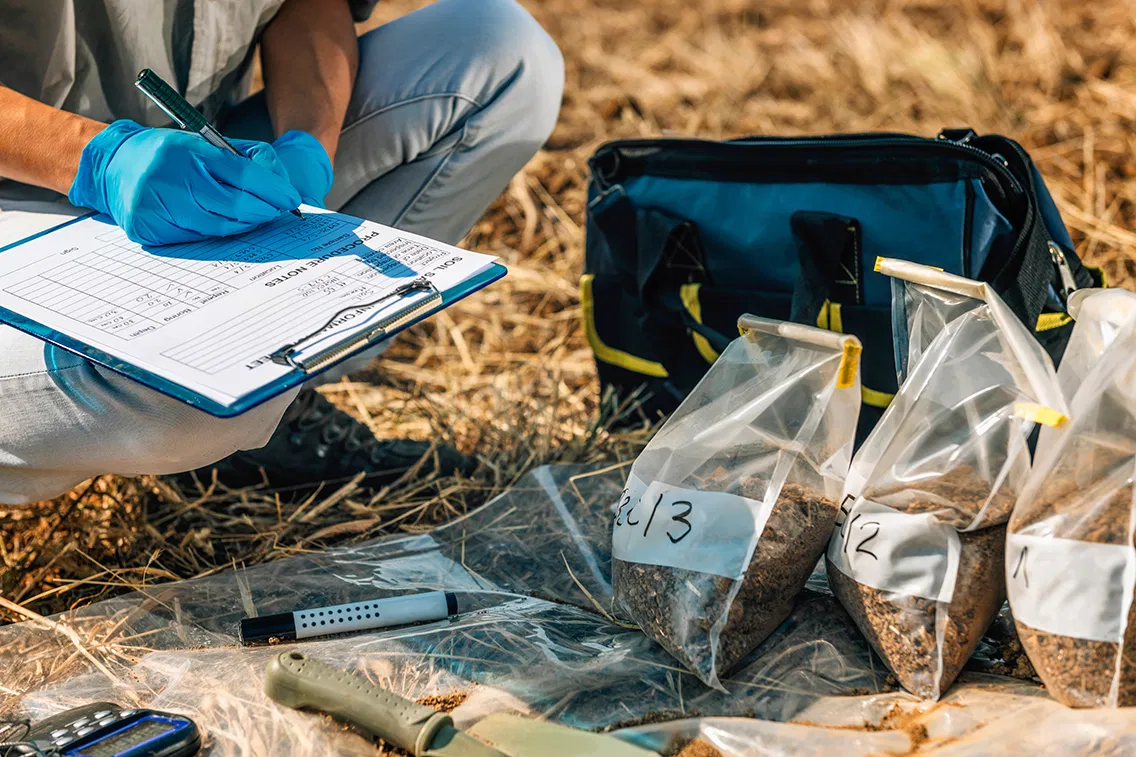
Step-by-Step: How to Build Your Soil Archive
You don't need a PhD or a million-dollar laboratory to start documenting your land's legacy. You just need a shovel, some Sharpies, and a commitment to consistency.
1. Identify Your Sampling Zones
Don't just walk out and grab a random handful of dirt. Divide your land into "Management Zones." A north-facing slope with heavy clay should be archived separately from a flat, sandy bottomland. Use our Initial Soil Health (ISH) Assessment guidelines to help identify these zones.
2. The "Snapshot" Collection
For each zone, collect a core sample (ideally 0-6 inches and 6-12 inches deep).
- Pro Tip: Use a stainless steel soil probe to ensure consistency.
- The Goal: You want a representative "average" of that specific area.
3. Proper Processing and Storage
Microbes are living things, but for long-term physical archiving, we usually "air-dry" the samples.
- Spread the soil out on a clean surface (avoid direct sunlight) until all moisture is gone.
- Place the dried soil in a heavy-duty, BPA-free plastic bag or a glass jar.
- Labeling is everything. Include the date, the GPS coordinates (use your phone!), the previous crop, and any recent amendments.
4. Digital Documentation
A physical sample is only half the story. You need a digital "ledger" to accompany it. We recommend keeping a spreadsheet that tracks:
- Rainfall patterns for the year.
- Specific Rhizo Logic® applications.
- Observed weed pressure (weeds are just soil messengers telling you what’s wrong!).
- Yield data and Brix readings (nutrient density).
Systems-Thinking: Archiving the Living Ecosystem
When we look at soil, we aren't just looking at N-P-K (Nitrogen, Phosphorus, Potassium). We are looking at a living ecosystem. A truly restorative archive focuses on the Rhizo Logic®: the logic of the rhizosphere.

In a regenerative system, we are looking for the "Three Musketeers" of soil health: Protozoa, Nematodes, and Fungi. While the physical archive preserves the mineral and chemical state, your documentation should also include "Biological Snapshots."
We recommend performing a Soil Health Assessment annually. This doesn't just look at the dirt; it looks at the life in the dirt. By comparing your annual biological reports with your archived physical samples, you begin to see the "why" behind your success.
Beginner vs. Commercial: How Deep Should You Go?
For the Patio Gardener & Homeowner
You don't need a massive archive, but you should keep a "Yearly Jar." Every spring, before you plant your 5-gallon living soil kits, take a small jar of your starting medium. Label it. By year three, you will be able to see the visible change in soil structure (aggregation) and color (humus content).
For Commercial Operations
For those looking to implement the RSI Method, archiving is a non-negotiable part of your SOP (Standard Operating Procedure). We suggest archiving samples every 2-3 years per management zone. This data becomes your "proof of concept" when applying for organic certification or regenerative subsidies.
Common Mistakes to Avoid
- Contamination: Using a rusty shovel or a bucket that previously held fertilizer will skew your results. Keep your tools clean.
- Moisture: Archiving wet soil leads to anaerobic rot and mold. Always air-dry your physical archive samples unless you are doing a specialized "fresh-frozen" biological test.
- Vague Labeling: "Field 1" is not a label. "Field 1 - North Quadrant - Post-Cover Crop - May 2026" is a label.
- Ignoring the "Rhizo": Don't forget that the roots are where the magic happens. If you are archiving soil from a specific plant, try to include some of the rhizosphere (the soil directly clinging to the roots).
The Future of Your Legacy
The goal of soil restoration is to leave the land better than we found it. When you maintain a soil archive, you aren't just hoarding jars of dirt; you are building a roadmap for the next generation. You are providing the evidence that humans can be a regenerative force on this planet.
By using science-backed solutions like our Rhizo Logic® products, you are accelerating a process that used to take decades. Archiving allows you to watch that acceleration in real-time.

FAQ: Soil Archiving & Restoration
Q: Will the microbes stay alive in my archive?
A: If you air-dry the sample for long-term storage, most microbes will go into a dormant state or die. However, their DNA and the chemical markers they leave behind (like glomalin from fungi) remain. For "living" snapshots, you need a fresh lab assessment.
Q: How long can I keep a soil sample?
A: If kept dry, cool, and away from UV light, soil samples can last for over a century.
Q: Do I need to archive every year?
A: For most growers, a comprehensive archive every 2-3 years is sufficient. However, if you are making a major transition (e.g., moving from conventional to regenerative), we recommend a "Year 0" baseline immediately.
Q: Can I use Regen Soil to help me manage this data?
A: Absolutely. Our RSI Method is built on data-driven restoration. We can help you interpret your archive data and adjust your biological inputs accordingly.
Join the Regeneration
Ready to start your land's legacy? The best time to take your first archive sample was ten years ago. The second best time is today. If you're feeling overwhelmed by the technical side of soil biology, don't sweat it. Reach out to us at Regen Soil Contact and let’s get your soil on the path to recovery.
Let's stop just "farming" and start restoring. Your land: and your future harvests: will thank you.
What’s your biggest challenge when it comes to tracking your soil’s health? Drop a comment below or send us a message: we’d love to help you dig into the data!


