
The 4.3 pH Rescue: How to Save Your Hemp from a Coco Coir Crash
By Jeremy Standring
There is nothing quite like the sinking feeling of walking into your flower room and seeing your prized hemp canopy turning crispy. One day they are vibrant and reaching for the lights; the next, the leaf edges are burnt, bronze, and curling upward like they’ve been hit with a blowtorch.
We recently dealt with a case study involving a hemp cultivation setup using 2-gallon pots in a coco-hydro system. The grower was pushing high-EC crop steering, aiming for maximum yield, when the wheels fell off. Upon testing the runoff and the internal media, we discovered a rhizosphere pH that had crashed to a staggering 4.3.
At 4.3 pH, you aren’t just looking at a "slight imbalance." You are looking at a full-scale biological and chemical shutdown. In the world of high-performance cultivation, this is an emergency. Today, we’re going to break down why this happens in coco coir, how to fix it using the "3x Volume Flush," and why this specific headache is one of the strongest arguments for the living soil resilience we champion here at Regen Soil.
Why Coco Coir Crashes: The Buffering Problem
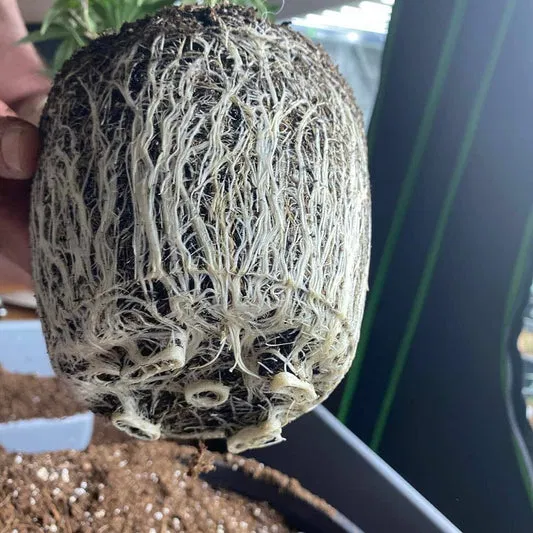
To understand the fix, we first have to understand the chemistry. Coco coir is a fantastic medium, it’s sterile, offers great aeration, and allows for precise control. However, that "control" is a double-edged sword. Unlike natural soil, coco lacks a robust natural buffering capacity.
In a soil system, minerals and organic matter act as a "shock absorber" for pH. In a coco-hydro system, the medium is essentially a placeholder. The pH of the rhizosphere (the area immediately surrounding the roots) is dictated almost entirely by your input and the plant’s ion exchange.
When hemp plants enter heavy flowering, their metabolic demands skyrocket. As they take up specific nutrients (like Nitrogen in the form of Ammonium), they release hydrogen ions (H+) back into the medium. In a small 2-gallon pot under high-EC steering, these hydrogen ions can accumulate rapidly. Without a buffer to neutralize them, the acidity spikes. Before you know it, your pH has plummeted from a healthy 5.8 to a toxic 4.3.
The Result: Nutrient Lockout
When the pH hits 4.3, you hit nutrient lockout. At this level of acidity, essential elements like Calcium, Magnesium, and Phosphorus become chemically unavailable to the plant, even if they are sitting right there in the pot. Meanwhile, metals like Aluminum or Manganese can become soluble at toxic levels. The "burnt" edges you see aren't necessarily from too much fertilizer, they are often the plant literally starving and suffering from elemental toxicity simultaneously.

The Emergency Protocol: The 3x Volume Flush
If you catch your pH at 4.3, you don't have time to "slowly adjust" your reservoir. You need to reset the chemistry of the root zone immediately. We recommend the 3x Volume Flush.
This is a technical maneuver designed to physically push out the acidic salts and reset the coco coir buffering sites. Here is the math we used for our 2-gallon pot case study:
- Calculate the Volume: For a 2-gallon pot, 3x volume means 6 gallons of water per plant.
- The Input pH: Do not use 5.8 pH water for this flush. To pull a 4.3 pH up to the target, you need to use water adjusted to 7.0 pH. This creates a "swing" that neutralizes the acidity more effectively.
- The Process: Pour the 7.0 pH water through the medium steadily. You want to see heavy runoff.
- The Target: You are looking for the runoff pH to return to the 5.8–6.2 "sweet spot." Specifically, for coco, we aim to land right at 5.8 by the end of the flush.
Why the Math Matters
Many growers make the mistake of pouring just a gallon or two through. In a 2-gallon pot, a single gallon of water barely moves the needle because of the cation exchange capacity of the coco. You have to physically displace the "old" water and the accumulated salts trapped in the fibers of the coir.
Returning to the Sweet Spot
Once the flush is complete and your runoff is back in the high 5s, you cannot simply go back to what you were doing. The plant is stressed, and the medium's buffer is gone.
- For Beginners: Start your next feeding at a lower EC (Electrical Conductivity) than your previous "steering" levels. Give the plant 48 hours to stabilize.
- For Experienced Growers: Re-introduce a Cal-Mag heavy nutrient solution. Coco coir has a high affinity for Calcium. When the pH crashes, Calcium is usually the first thing to get kicked off the exchange sites.
- For Commercial Operations: If this is happening across a large canopy, check your irrigation frequency. pH crashes in coco are often a result of "dry backs" that are too long, causing salts to concentrate and pH to drop.

Hydroponic Headaches vs. Living Soil Resilience
This 4.3 pH crisis highlights the fundamental difference between hydroponic management and living soil systems. In the case study above, the grower was essentially a chemist, constantly fighting to keep a fragile system in balance.
In a living soil environment, such as one utilizing Rhizo Logic™ products, this type of crash is almost unheard of. Why?
- Microbial Buffering: Beneficial bacteria and fungi create a "bio-film" around the roots that regulates the local pH environment.
- Carbon Buffering: The organic matter in living soil acts as a massive reservoir that can absorb excess hydrogen ions without the pH shifting wildly.
- Systems Thinking: Instead of forcing the plant to adapt to a nutrient solution, living soil allows the plant to "trade" with microbes for what it needs, keeping the rhizosphere stable naturally.
We often tell our clients at Regen Soil: "In coco, you are the life support system. In living soil, the ecosystem is the life support." If you're tired of the constant "pH dance," it might be time to look at our RSI Method for a more stable, regenerative approach.
Preventive Measures for Coco Growers
If you aren't ready to make the jump to living soil yet, you can still prevent the 4.3 crash by implementing these habits:
- Daily Runoff Monitoring: Don't just check your reservoir. Check what is coming out of the bottom of the pots. If your input is 5.8 and your runoff is 5.2, you are heading for a crash.
- Maintain Moisture: Never let coco go bone dry. As coco dries, the concentration of salts in the remaining water spikes, which drives the pH down.
- Quality Sourcing: Ensure you are using high-quality, pre-buffered coco. Lower-grade coco is often loaded with sodium and potassium, which makes pH management a nightmare from day one.
Summary: Lessons from the Crash
The 4.3 pH crash is a "trial by fire" for many hemp growers. It teaches you the importance of the rhizosphere pH and the limitations of inert media. While the 3x Volume Flush can save your crop in the short term, the long-term solution is understanding the relationship between your media, your nutrients, and your plant's biology.
At Regen Soil, we specialize in helping growers transition from these high-stress "reset" cycles to sustainable, high-yielding systems. Whether you need an Initial Soil Health Assessment (ISH) or you're looking to boost your current biological activity with Ultra Bio Boost, we are here to help you move from crisis management to cultivation mastery.
FAQ: Navigating pH Crashes in Hemp
Q: Can I use vinegar or lemon juice to adjust my pH during the flush? A: We don't recommend it for a 3x Volume Flush. These are "weak" acids/bases and are not stable enough for a massive chemical reset. Stick to professional pH Up (Potassium Hydroxide) or pH Down (Phosphoric Acid) to ensure the reset holds.
Q: My leaves are already brown. Will they turn green again after the flush? A: Unfortunately, no. Once a leaf edge is "burnt" or necrotic, that tissue is dead. However, the new growth should emerge healthy and green within 3–5 days if the fix was successful.
Q: Does living soil ever need a flush? A: Rarely. In a true living soil system, we avoid "flushing" because it can wash away the beneficial microbial life we’ve worked so hard to build. Instead, we "top-dress" or adjust our biological inputs to steer the soil back into balance.
Q: Is 4.3 pH low enough to kill my plants? A: Yes. If left uncorrected for more than a few days, the root hairs will begin to dissolve, and the plant will eventually wilt and die from a total lack of water and nutrient uptake.
Need a hand getting your facility back on track? Contact us today for a consultation. Let’s build a system that works with nature, not against it.


