
7 Mistakes You're Making with Regenerative Farming Practices (and How to Fix Them)
By Jeremy Standring
Regenerative agriculture is more than just a buzzword; it is a fundamental shift in how we interact with the land. At Regen Soil, we see many growers, from home cannabis enthusiasts to large-scale commercial operations, attempt to make the leap from conventional methods to regenerative systems. While the intention is noble, the execution often falters because we try to apply "conventional thinking" to a biological framework.
We aren't just swapping one bottle of synthetic fertilizer for a bottle of organic nutrients. We are rebuilding an entire ecosystem. In our work with soil health consulting, we’ve identified seven recurring mistakes that can stall your progress or even lead to crop failure.
Here is how to identify these pitfalls and, more importantly, how to fix them using science-backed soil restoration techniques.
1. Skipping a Comprehensive Site and Soil Assessment
The most common error we see is "blind farming." Many growers jump into cover cropping or no-till practices without first understanding the unique baseline of their land. Every plot of land has a history, past chemical use, compaction layers, and specific microbial voids.
The Fix:
You must spend time observing your landscape. How does water move during a heavy rain? Where does the frost settle? Beyond observation, you need data. We recommend starting with an Initial Soil Health (ISH) Assessment. This isn't your standard N-P-K test. We look at the microbial populations, the fungal-to-bacterial ratios, and the actual biological activity within your rhizosphere.
Before you plant, you need to know if you are working with living soil or simply dirt that needs a jumpstart.

2. Ignoring the Hydrological Cycle (Water Flow)
Regenerative agriculture and water management are inseparable. We often see growers focusing so much on "the biology" that they forget that biology requires a consistent, structured water environment. Poor drainage leads to anaerobic conditions (root rot), while poor water retention leads to drought stress and microbial die-off.
The Fix:
Make water your first design priority. Use the "Slow, Spread, Sink" method.
- Slow the water down using mulches and cover crops to prevent erosion.
- Spread the water across the landscape using swales or contour planting.
- Sink the water into the soil profile by improving soil structure and organic matter.
Increasing your soil organic matter (SOM) by just 1% can allow your soil to hold an additional 20,000 gallons of water per acre. This is where soil restoration truly pays off in resilience.
3. Overloading the System (Complexity Overload)
It is easy to get excited and want to implement a food forest, a no-till vegetable garden, an organic cannabis patch, and a composting program all in year one. We call this "system fatigue." When you spread your energy too thin, maintenance slips, and the biological systems you’re trying to build begin to collapse.
The Fix:
Start with a manageable "Zone 1" approach. Master your living soil in a smaller area before scaling. Integration beats accumulation. It is better to have one thriving, biologically active acre than ten acres of neglected, weedy "regenerative" land. Once your primary system is stable and the Rhizo Logic® microbial communities are established, then you can expand.
4. Scaling Practices Too Quickly Without Trials
In the excitement of seeing a "Bio-boost" result on a small scale, some farmers "bank the whole farm" on a new practice. This is high-risk. Regenerative transitions take time: usually three to five years to reach full biological equilibrium.
The Fix:
Adopt a "Trial and Measure" mindset. Dedicate 5-10% of your acreage or a few rows of your garden to a new technique.
- A vs. B Analysis: Compare your standard practice against the new regenerative practice.
- Metrics of Success: Look beyond just yield. Measure profitability (reduced input costs), soil water-holding capacity, and pest resilience.
Use tools like the Regen Soil Pulse to monitor real-time data. Tracking your EC (Electrical Conductivity) and moisture levels helps you understand how your biological changes are affecting the root zone in real-time.

5. The "Cold Turkey" Input Trap
This is perhaps the most dangerous mistake for commercial viability. Growers often stop all synthetic inputs (fertilizers, fungicides) overnight. However, if your soil biology is currently dormant or depleted, your plants will have no way to access nutrients. This leads to massive yield drags and "the transition dip."
The Fix:
Transition, don't just stop. You must replace chemistry with biology.
As you reduce synthetic N-P-K, you must introduce Terrabiotics like Bio-boost to stimulate the indigenous microbes. Bio-boost acts as a catalyst, helping the soil transition from being "fed" by salts to "cycling" nutrients through microbial action.
Think of it like a relay race: you don't let go of the synthetic baton until the biological runner (the microbes) has a firm grip on the nutrient cycle.
6. Neglecting the Rhizosphere (The "Rhizo Logic" Principle)
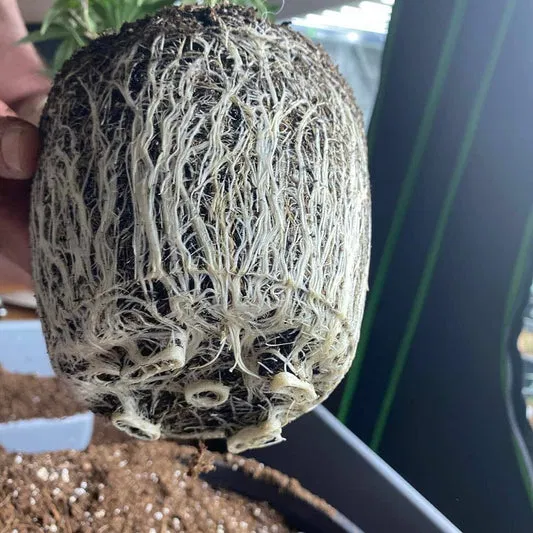
Many beginners focus only on the top few inches of soil or the visible plant growth. However, regenerative success is determined by the rhizosphere: the narrow region of soil directly influenced by root secretions and associated microorganisms.
The Fix:
Focus on root health. We utilize Rhizo Logic® products specifically to ensure that the relationship between the plant and the soil is optimized.
- Microbial Diversity: You need more than just a few strains of bacteria. You need a diverse "workforce" of fungi, protozoa, and beneficial bacteria.
- Fungal:Bacterial (F:B) Ratios: Different crops require different ratios. For example, cannabis and many perennials thrive in a fungal-dominant environment. Understanding these fungal/bacteria ratios is critical for long-term success.

7. Treating Symptoms Instead of Root Causes
When a grower sees a pest like fungus gnats or a disease like grey mold, the conventional instinct is to spray. In regenerative farming, a pest is not the problem; it is a symptom of a biological imbalance.
The Fix:
Practice "Systems-Thinking." If you have fungus gnats, don't just reach for a pesticide. Ask: Is my soil too wet? Is there an excess of decomposing organic matter without enough protozoa to balance the cycle?
By using a complete guide to tackling fungus gnats, you’ll learn that balancing the ecosystem is more effective than any "organic" spray.
Comparison: Conventional vs. Regenerative Management
| Feature | Conventional Thinking | Regenerative (Regen Soil) Approach |
|---|---|---|
| Nutrient Source | Synthetic Salts (N-P-K) | Microbial Nutrient Cycling |
| Pest Management | Eradication (Pesticides) | Ecosystem Balance (Predators/Health) |
| Soil Structure | Mechanical Tillage | Biological Aeration (Roots/Microbes) |
| Water | Irrigation-Dependent | Increased Water-Holding Capacity |
| Primary Goal | Maximum Yield at Any Cost | Profitability & Soil Vitality |
Deep Dive: Why Biology Matters
We emphasize Rhizo Logic® (Living Soil) because, in a truly regenerative system, the plant is the driver. Through photosynthesis, plants pump carbon sugars (exudates) into the soil to "hire" specific microbes to go find the minerals the plant needs. When we use high-salt fertilizers, we break this contract. The plant stops producing exudates, the microbes starve, and the soil structure collapses.
Restoring this "biological contract" is the core of our RSI Method.
Frequently Asked Questions (FAQ)
Q: How long does it take to see results with regenerative practices?
A: While you can see microbial activity increase within weeks of using Bio-boost, true soil structure restoration typically takes 1-3 years of consistent management.
Q: Can I use regenerative practices in containers?
A: Absolutely. We specialize in Living Soil vs. Super Soil comparisons for indoor and outdoor growers. Container growing requires more attention to moisture consistency but follows the same biological principles.
Q: Is regenerative farming more expensive?
A: Initially, there is an investment in biology (cover crops, microbial inoculants like Rhizo Logic®). However, over time, your costs for fertilizers, pesticides, and water decrease significantly, leading to higher net profitability.
Q: Do I still need to test my soil if I'm "going natural"?
A: More than ever. You cannot manage what you do not measure. Regular assessments ensure your fungal-to-bacterial ratios are moving in the right direction.
Final Thoughts
Regenerative farming is a journey of unlearning as much as it is of learning. It requires us to step back and let nature do the heavy lifting, supported by the right biological tools and scientific data. Whether you are struggling with purple leaves or looking to scale a commercial farm, the answer always lies in the health of the soil.
Are you ready to stop guessing and start growing?
If you’re feeling overwhelmed by the transition, we’re here to help. Reach out to us for a personalized consultation or check out our blog for more technical guides on building a thriving ecosystem.
Let’s grow together.


